
We were appointed by a developer client as landscape architects for this urban infill residential project in East London. Initially, we prepared a sketch landscape design with the client and wider design team. We then developed the proposals to support a detailed planning application. As part of our landscape architecture services, we prepared the landscape architect’s information required for submission to the planning authority. We also produced a detailed Landscape Design Statement to explain the design approach and proposed landscape works.
Importantly, this project forms the second phase of a residential scheme for which our landscape architects previously secured planning consent. The same developer appointed us for both phases. Consequently, we were able to develop a consistent landscape strategy across the wider development.
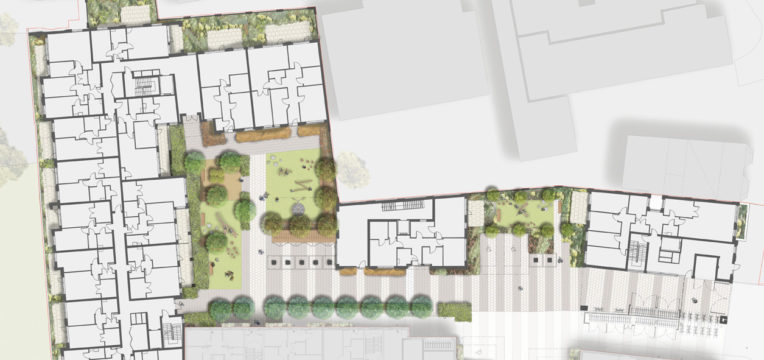
The site occupies a deep urban plot with a narrow frontage onto Bow Road. Therefore, the landscape design needed to respond carefully to the restricted site access. The second phase also shares the Bow Road entrance with the first phase. As a result, a key part of our landscape architect’s brief was to seamlessly integrate both phases. We created a unified public realm that connects the two developments.
In addition, the design team considered the construction sequence at the planning stage. The first phase would already be occupied when construction of the second phase began. Therefore, the landscape proposals needed to maintain a practical relationship between the completed and proposed areas.
We treated the entire residential landscape as a pedestrian-priority environment. However, the shared carriageway also provides occasional vehicular access. This allows essential servicing and access to disabled parking spaces. We designed the route as a shared surface, with no kerbs separating the footway from the carriageway. Furthermore, we continued the paving bands from the adjacent residential development into the new phase. This approach creates visual continuity across the wider public realm.
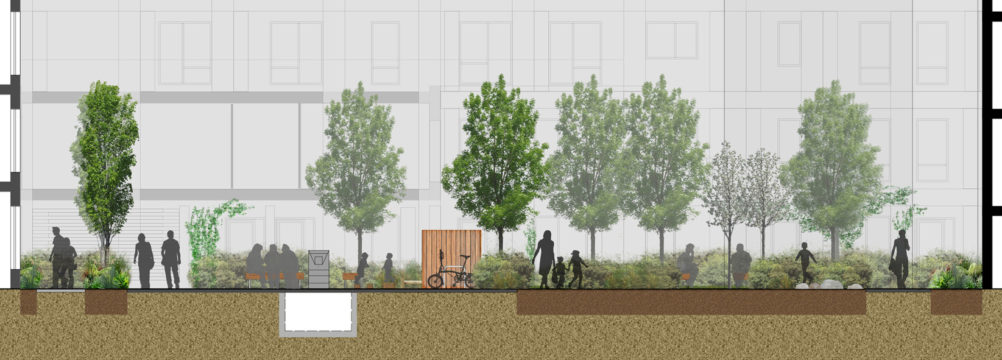
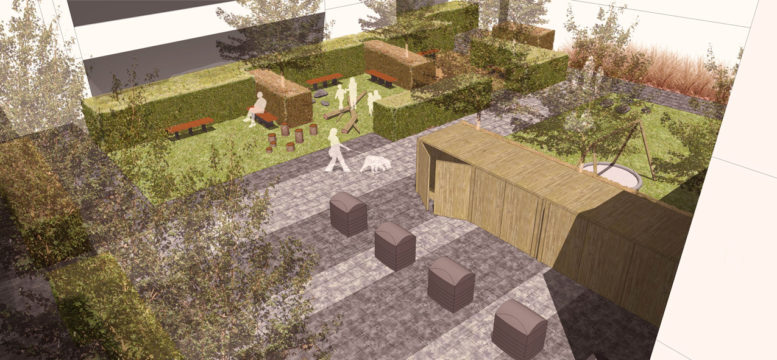
We also integrated two toddler play areas within the communal amenity spaces. These areas maximise the use and flexibility of the available external space. In turn, the landscape design provides residents with accessible and functional communal amenity.
Finally, our landscape architecture proposals accommodated the project’s operational requirements. These included cycle storage, refuse storage, two disabled parking spaces, fire tender access and refuse vehicle access. As a result, the landscape architect’s design successfully combines residential amenity, pedestrian movement, servicing and access within a constrained urban site.
Client: Aitch Group
Architect: StockWool