


Our landscape architects were appointed by a contractor client to prepare landscape information for a detailed planning submission. The proposed 0.4ha residential development occupies a brownfield plot. We then prepared the full landscape architect’s tender and construction information packages. Finally, we will monitor the external works as they progress on site.
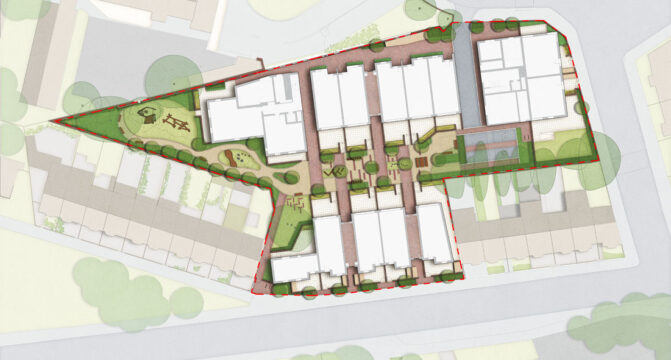
The site currently contains a respite care centre, outbuildings and associated gardens. The irregular plot sits between existing residential properties and their rear gardens. These properties adjoin the north-west and south-west boundaries. In addition, the site fronts both Leyton Green Road and Matlock Road. A level change of approximately 1m occurs across the site.
Several mature trees stand within the site boundary. These include trees at the northern corner, a group beside Leyton Green Road and a row at the south-west corner. The landscape architect’s design retains the majority of these trees. Consequently, the proposed landscape works respond closely to the existing vegetation and site constraints.
The site layout continues the existing residential terrace along Leyton Green Road. To the rear, a larger building mass runs north to south. The design team developed this arrangement to minimise impacts on retained trees. As a result, the layout creates a central communal courtyard and open green space at the northern part of the site.
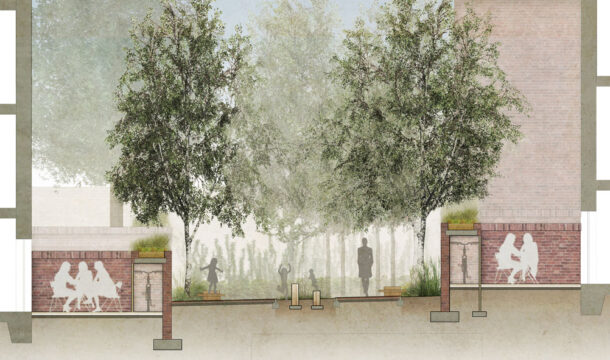
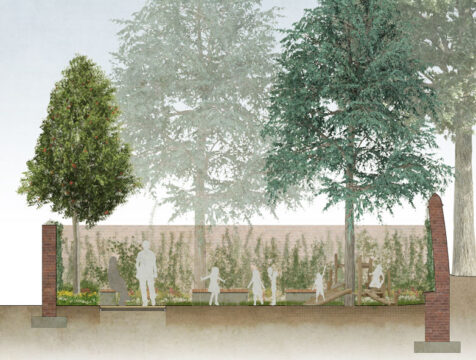
The predominantly paved communal courtyard provides a shared space for residents. Here, residents can meet, relax and socialise. The landscape architect integrated incidental play features for children under five within the courtyard. Meanwhile, the open green space to the north provides a softer and less formal setting. This area supports social use and play for children up to 11 years old.
Two accessible parking spaces sit to the south of the communal courtyard. Furthermore, the landscape design provides clear connections between the residential buildings, courtyard and external spaces. The landscape architect carefully considered these relationships throughout the design process.
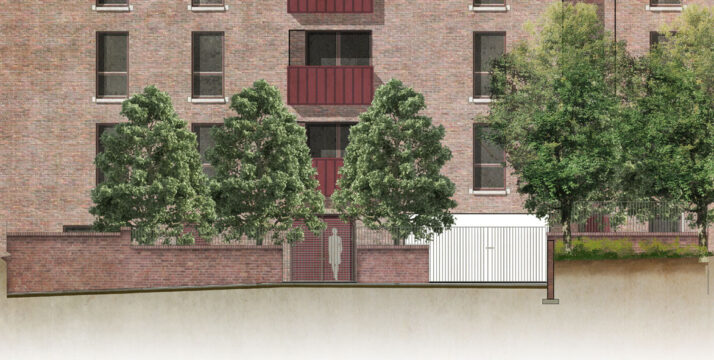
The site boundaries provide a secure and clearly defined edge to the development. Where possible, the landscape architect retained and improved the existing boundary treatments. New perimeter walls use brickwork to complement the proposed buildings. Railings provide additional security where required.
The landscape architect also incorporated Sustainable Urban Drainage Systems (SuDS) into the landscape design. These measures serve the majority of the proposed paved areas. In addition, the courtyard landscape incorporates a below-ground attenuation tank. The drainage strategy therefore forms an integral part of the overall landscape architecture.
Finally, the landscape architect reviewed comments received during public consultation. Where appropriate, the design team incorporated these comments into the landscape design. This approach helped create an external environment that responds to the site’s context, residents and wider community.
Landscape Institutes Work Stages: 1 to 6
Client: London Borough of Waltham Forest
Architect: Fraser Brown McKenna Architects
Developer/ Contractor: Jerram Falkus