
We were appointed by a developer client to prepare a sketch landscape design for this proposed residential development. We then developed landscape architect’s information to support the detailed planning submission. The scheme provides 18 self-contained flats.
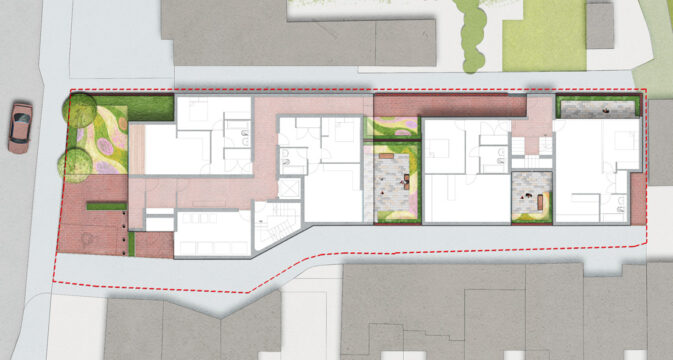
The development plot forms an elongated rectangle, with its narrow western boundary facing Amity Grove. Existing residential buildings adjoin the northern and eastern boundaries. To the south, the plot boundary follows an existing shared access. This access serves the rear of several commercial units on Coombe Lane and will therefore remain in use. The application site covers approximately 800m².
The existing site contains a dilapidated commercial building and areas of hardstanding used for car parking. In addition, the site has no existing trees or significant vegetation along its boundaries. Consequently, the landscape design provides an opportunity to introduce new planting and improve the site’s visual quality.
The proposed building sits slightly back from Amity Grove along its western elevation. The built form extends across most of the plot depth, with a small break at its centre. To the south, the landscape architect retained and enhanced the existing communal vehicular access.
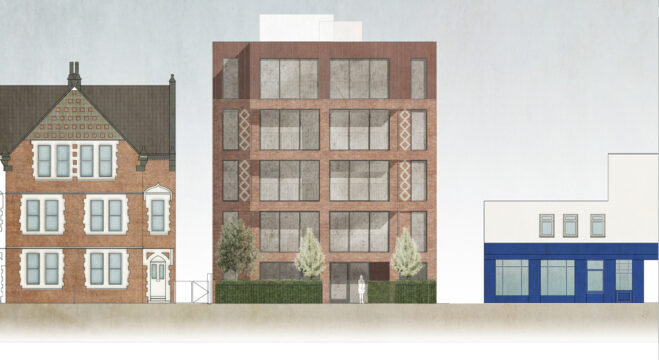
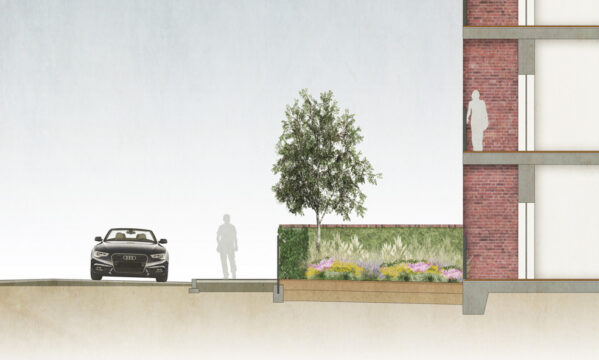
At the Amity Grove frontage, the building setback creates a high-quality communal entrance. The landscape design uses high-quality brick paving to define this arrival space. It also incorporates a dedicated accessible parking space, ornamental planting and new trees. Together, these elements improve the streetscape and soften the visual impact of the proposed residential development.
The brick paving continues from the main entrance into the internal communal area. It then extends through the external communal walkway, providing clear pedestrian access to the dwellings at the rear of the site. This approach creates a consistent landscape treatment throughout the development.
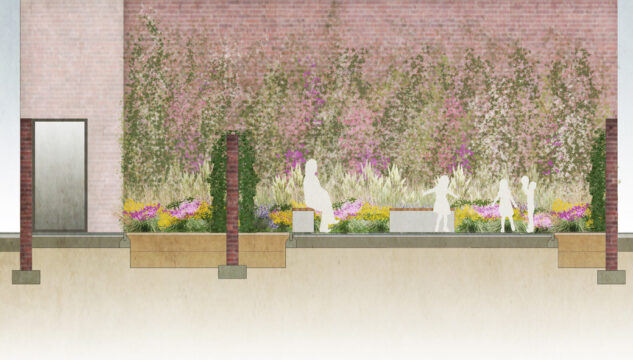
The building also incorporates several recessed external spaces. These courtyards provide opportunities for high-quality paving, groundcover planting and wall climbers. As a result, residents will benefit from attractive and usable private external spaces.
The landscape architect carefully considered Part M compliance, pedestrian safety and wayfinding throughout the pedestrian circulation strategy. The design provides clear routes between the communal entrance, shared spaces and individual dwellings. Furthermore, the landscape layout supports safe and accessible movement throughout the site.
Our landscape architects carefully selected the planting palette to suit the site’s environmental conditions. In particular, the courtyard planting will tolerate the potentially shady conditions within these spaces. Across the wider landscape scheme, the planting also supports biodiversity. It will provide valuable opportunities for pollinating insects and other fauna while adding seasonal interest and visual amenity.
Overall, the landscape architecture strategy combines practical circulation, high-quality materials and ecological planting. It creates an attractive residential setting while responding positively to the site’s urban context.
Landscape Institutes Work Stages: 2 to 4a
Client: Heritance Land Capital
Architect: Fraser Brown Mackenna Architects
Developer/ Contractor: Karrada Developments