
Our landscape architect team was appointed by a developer client to prepare the landscape design for this proposed residential development. We then prepared landscape architect information to support the detailed planning submission.
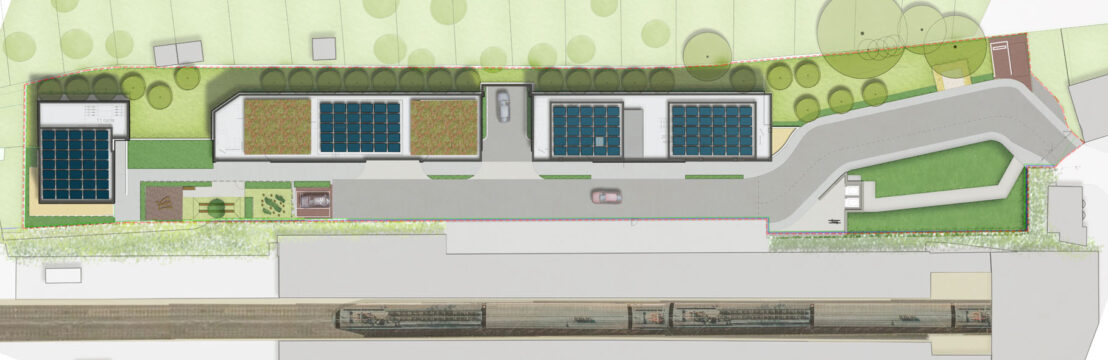
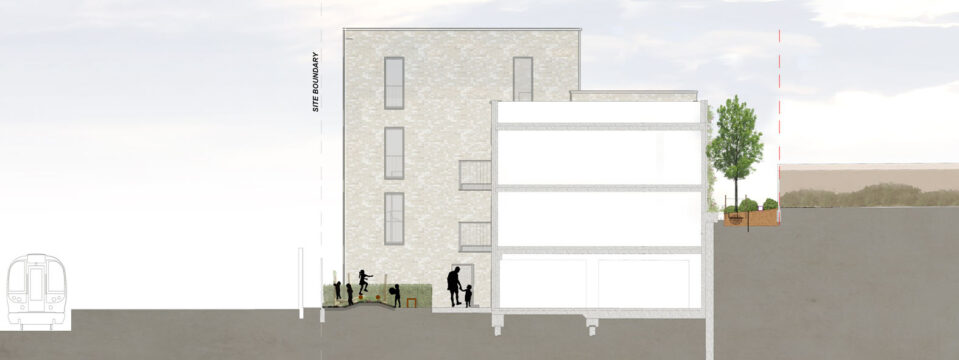
The development plot forms an elongated rectangle directly beside Hornchurch Tube station. A dilapidated Tube network building currently occupies the site and will be demolished. The development area measures approximately 0.36ha. The southern boundary adjoins one of the station platforms at a similar level. To the north, the site adjoins rear gardens serving neighbouring private dwellings. These gardens sit approximately 4.5m above the development plot, with a steep bank connecting the two levels. The site entrance is from Station Lane at the eastern end. This area also sits approximately 4.5m above the development plot.
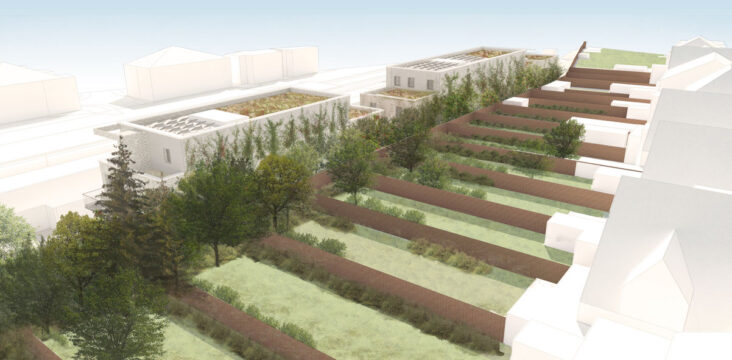
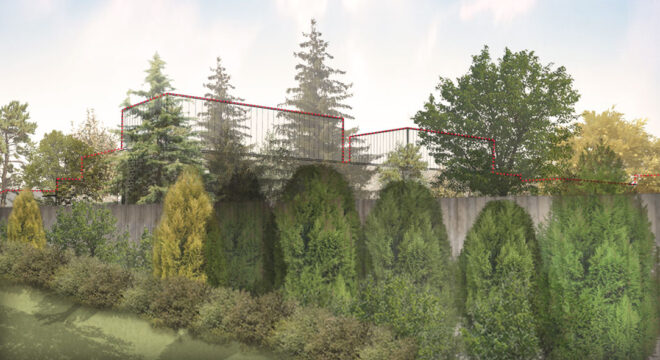
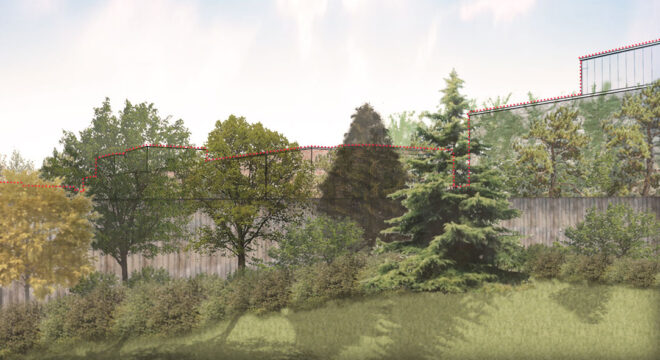
A significant number of existing trees grow within the steep northern boundary bank. However, most of these trees need removal to facilitate the development. Consequently, the planting strategy for the north-facing building elevations was a key landscape architecture consideration. The proposed planting aims to reduce the visual mass of the new buildings. Mature trees and climbers attached to the north-facing elevations form an important part of this strategy. We also prepared landscape visualisations to demonstrate the proposed screening. These showed how new trees, climbers and retained vegetation would integrate the buildings into the surrounding landscape. In addition, all specified tree species are of native provenance.
The proposed development comprises three distinct building blocks arranged along the length of the plot. Together, they provide 27 residential dwellings across three and four storeys. Given the site’s close proximity to Hornchurch Tube station, parking provision is limited to four disabled parking bays.
Part M compliance formed a key consideration for the landscape architect. The principal challenge was the 4.5m level difference between the site entrance and the dwelling entrances. To maximise the developable area, the design includes a steep pedestrian access route. However, this route is not Part M compliant. Therefore, the accessible route uses a level pedestrian path with a platform lift at its end. The lift provides access to the lower development level. Furthermore, clear delineation between the carriageway and footways improves pedestrian safety. It also provides a straightforward wayfinding strategy.
The shared amenity space is located at the western end of the development plot. The landscape design focuses on play and provides equipment for children aged 0 to 11 years. Perimeter planting helps define the space and integrate it with the wider landscape. Seating also provides comfortable areas for parents and carers. Overall, the landscape architecture responds to the site’s challenging levels, existing vegetation, accessibility requirements and close relationship with Hornchurch Tube station.
Landscape Institutes Work Stages: 2 to 3
Client: Caerus Developments
Architect: Caerus Developments